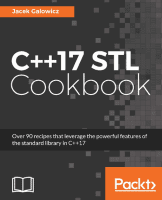
C++17 is on the way, and I’m glad to see more books that stay on the bleeding edge of C++ adaptation. Today I’d like to present a book that focuses on the Standard Library.
Is this another great book?
TL; DR: Yes :) But read more to see why :)
Writing multithreaded code is hard. You want to utilize all of the machine’s processing power, keep code simple and avoid data races at the same time.
Let’s see how C++17 can make writing parallel code a bit easier.
Intro With C++11⁄14 we’ve finally got threading into the standard library. You can now create std::thread and not just depend on third party libraries or a system API.
The new C++ Standard - C++17 - is near the end to be accepted and published. There’s already a working draft, and not that long ago it went to the final ISO balloting. It’s a good occasion to learn and understand what are the new features.
Let’s start slowly, and today we’ll look at language/library fixes and removed elements.
Let’s say we have the following code:
LegacyList* pMyList = new LegacyList(); ... pMyList->ReleaseElements(); delete pMyList; In order to fully delete an object we need to do some additional action.
How to make it more C++11? How to use unique_ptr or shared_ptr here?
Intro We all know that smart pointers are really nice things and we should be using them instead of raw new and delete.
Maybe I’ll be boring with this note, but again I need to write that this was another good year for C++!
Here’s a bunch of facts:
Visual Studio 2015 was released with great support for C++14⁄17 and even more experimental features. Long-awaited GCC 5.0 was released at the beginning of the year.
Some time ago I’ve seen an inspiring talk from CppCon 2013: “C++ Seasoning” by Sean Parent. One of the main points of this presentation was not to use raw loops. Instead, prefer to use existing algorithms or write functions that ‘wraps’ such loops. I was curious about this idea and searched for nice code examples.
Mister C was a cool guy. C could make amazing things with just ordinary text files. He used to grab bunch of them and produce magic binary forms. He could make a spinning cube, web server, or even an operating system.
One time he was running through a plain header file.