When you read articles or reference pages for std::any, std::optional or std::variant you might notice a few helper types called in_place_* available in constructors.
Why do we need such syntax? Is this more efficient than “standard” construction?
Intro We have the following in_place helper types:
std::in_place_t type and a global value std::in_place - used for std::optional std::in_place_type_t type and a global value std::in_place_type - used for std::variant and std::any std::in_place_index_t type and a global value std::in_place_index - used for std::variant The helpers are used to efficiently initialise objects “in-place” - without additional temporary copy or move operations.
Writing articles about modern C++ features is a lot of fun, but what’s even better is to see how you use those new things in real world.
Today I’m happy to present a guest post article from JFT who was so kind to describe his project where he uses several C++17 features.
Last week you might have read about a few examples of parallel algorithms. Today I have one more application that combines the ideas from the previous post.
We’ll use parallel algorithms and the standard filesystem to count words in all text files in a given directory.
The Case In my previous post, there were two examples: one with iterating over a directory and counting the files sizes and the next one about counting words in a string.
MSVC (VS 2017 15.7, end of June 2018) is as far as I know the only major compiler/STL implementation that has parallel algorithms. Not everything is done, but you can use a lot of algorithms and apply std::execution::par on them!
Have a look at few examples I managed to run.
Two weeks ago I asked you for help: I wanted to build a wall of examples of std::optional. I’m very grateful that a lot of you responded and I could move forward with the plan!
You’re amazing!
Let’s dive in the examples my readers have sent me!
A Reminder To remind, I asked for some real-life examples of std::optional.
Around the time C++17 was being standardized I saw magical terms like “discriminated union”, “type-safe union” or “sum type” floating around. Later it appeared to mean the same type: “variant”.
Let’s see how this brand new std::variant from C++17 works and where it might be useful.
The Basics In my experience, I haven’t used unions much.
Show me your code!
I’d like to run a little experiment.
Let’s build a wall of examples of std::optional!
Intro In the last three articles of my C++17 STL series I’ve been discussing how to use std::optional. I can talk and talk… or write and write… but I’m wondering how do you use this wrapper type?
In my last two posts in the C++17 STL series, I covered how to use std::optional. This wrapper type (also called “vocabulary type”) is handy when you’d like to express that something is ‘nullable’ and might be ‘empty’. For example, you can return std::nullopt to indicate that the code generated an error… but it this the best choice?
Let’s take a pair of two types <YourType, bool> - what can you do with such composition?
In this article, I’ll describe std:optional - a new helper type added in C++17. It’s a wrapper for your type and a flag that indicates if the value is initialized or not. Let’s see where it can be useful and how you can use it.
There are many situations where you need to express that something is “optional” - an object that might contain a value or not. You have several options to implement such case, but with C++17 there’s probably the most helpful way: std::optional.
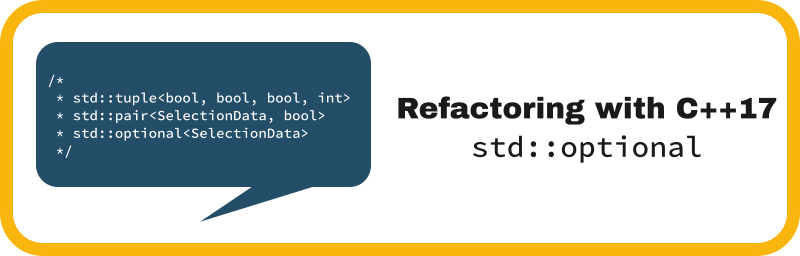
For today I’ve prepared one refactoring case where you can learn how to apply this new C++17 feature.
Let’s have a quick overview of another book related to Modern C++ and The Standard Library. This time I picked Rainer Grimm’s book the author of the modernescpp blog.
Read more if you’d like to win C++ book bundle! :)
The book The C++ Standard Library
What every professional C++ programmer should know about the C++ standard library
The new C++ standard brings many useful additions to the Standard Library. So far we’ve discussed bigger features like the filesystem or parallel algorithms. Today, I want to focus on smaller, but also handy things.
For example, there are utils for handling type safe unions, replacement of void*, string searchers and much more.