Following the pattern for other ISO C++ Meetings, I prepared a blog post where you’ll learn about:
The current status of C++20 an overview about the Belfast meeting (4th till 9th Nov) a few interesting papers that are worth reading Let’s start!
Disclaimer: the view presented here is mine and does not represent the opinion of the entire ISO C++ committee.
Two weeks ago, I showed you a sample that can detect if a function has a given overload. The example revolved around std::from_chars - low-level conversion routine for C++17. In the example, some “heavy” template patterns helped me to write the final code (most notably std::void_t and if constexpr). Maybe there are some other techniques we can use to check if a feature is available or not?
Today is the start day of Summer C++ISO meeting, this time in Cologne, Germany! This is the “feature-complete” meeting for C++20. It’s the last time we’ll see some new elements that are merged into the working draft.
Let’s see what’s already in C++20 and let’s have a look at some smaller, but very handy proposals that might get into the standard.
In the first part of the series we looked at lambdas from the perspective of C++03, C++11 and C++14. In that article, I described the motivation behind this powerful C++ feature, basic usage, syntax and improvements in each of the language standards. I also mentioned several corner cases.
Now it’s time to move into C++17 and look a bit into the future (very near future!
A few weeks ago I gave another talk at my local C++ user group. We discussed recent “goodies” from C++ and tools that can increase productivity.
Intro In my post for the “C++ summary at the end of 2017” I mentioned that we could see a considerable improvement in the area of tooling for the language.
The C++ Standard moves at a fast pace. Probably, not all developers caught up with C++11⁄14 yet and recently we got C++17. Now it’ time to prepare C++20!
A few weeks ago The C++ Committee had an official ISO meeting in Jacksonville, FL (12-17 March 2018) where they worked hard on the new specification.
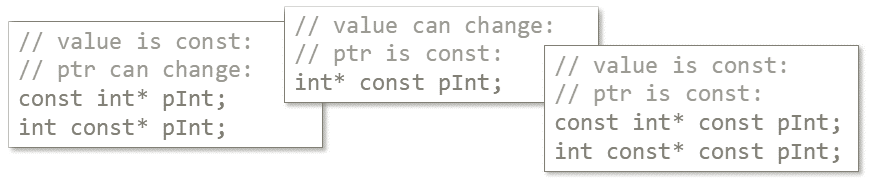
Inside const methods all member pointers become constant pointers.
However sometimes it would be more practical to have constant pointers to constant objects.
So how can we propagate such constness?
The problem Let’s discuss a simple class that keeps a pointer to another class. This member field might be an observing (raw) pointer, or some smart pointer.
Have you ever used the pimpl idiom in your code? No matter what’s your answer read on :)
In this article I’d like to gather all the essential information regarding this dependency breaking technique. We’ll discuss the implementation (const issue, back pointer, fast impl), pros and cons, alternatives and also show examples where is it used.