Thank you for all the comments about the string_view performance! Last week I got a lot of feedback on how to improve the initial string split code.
Have a look at how can we update the code and get some better performance.
Intro Last week I showed a few examples of string_view.
How much is std::string_view faster than standard std::string operations?
Have a look at a few examples where I compare std::string_view against std::string.
Intro I was looking for some examples of string_view, and after a while, I got curious about the performance gain we might get.
string_view is conceptually only a view of the string: usually implemented as[ptr, length].
When you read articles or reference pages for std::any, std::optional or std::variant you might notice a few helper types called in_place_* available in constructors.
Why do we need such syntax? Is this more efficient than “standard” construction?
Intro We have the following in_place helper types:
std::in_place_t type and a global value std::in_place - used for std::optional std::in_place_type_t type and a global value std::in_place_type - used for std::variant and std::any std::in_place_index_t type and a global value std::in_place_index - used for std::variant The helpers are used to efficiently initialise objects “in-place” - without additional temporary copy or move operations.
Writing articles about modern C++ features is a lot of fun, but what’s even better is to see how you use those new things in real world.
Today I’m happy to present a guest post article from JFT who was so kind to describe his project where he uses several C++17 features.
Last week you might have read about a few examples of parallel algorithms. Today I have one more application that combines the ideas from the previous post.
We’ll use parallel algorithms and the standard filesystem to count words in all text files in a given directory.
The Case In my previous post, there were two examples: one with iterating over a directory and counting the files sizes and the next one about counting words in a string.
MSVC (VS 2017 15.7, end of June 2018) is as far as I know the only major compiler/STL implementation that has parallel algorithms. Not everything is done, but you can use a lot of algorithms and apply std::execution::par on them!
Have a look at few examples I managed to run.
With std::optional you can represent some Type or nothing. With std::variant you can wrap several variants into one entity. And C++17 gives us one more wrapper type: std::any that can hold anything in a type-safe way.
The Basics So far in the Standard C++, you had not many options when it comes to holding variable types in a variable.
Two weeks ago I asked you for help: I wanted to build a wall of examples of std::optional. I’m very grateful that a lot of you responded and I could move forward with the plan!
You’re amazing!
Let’s dive in the examples my readers have sent me!
A Reminder To remind, I asked for some real-life examples of std::optional.
Around the time C++17 was being standardized I saw magical terms like “discriminated union”, “type-safe union” or “sum type” floating around. Later it appeared to mean the same type: “variant”.
Let’s see how this brand new std::variant from C++17 works and where it might be useful.
The Basics In my experience, I haven’t used unions much.
Show me your code!
I’d like to run a little experiment.
Let’s build a wall of examples of std::optional!
Intro In the last three articles of my C++17 STL series I’ve been discussing how to use std::optional. I can talk and talk… or write and write… but I’m wondering how do you use this wrapper type?
In my last two posts in the C++17 STL series, I covered how to use std::optional. This wrapper type (also called “vocabulary type”) is handy when you’d like to express that something is ‘nullable’ and might be ‘empty’. For example, you can return std::nullopt to indicate that the code generated an error… but it this the best choice?
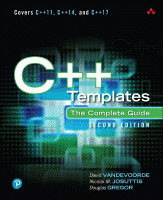
A few months ago I received a quite massive mail package with something that was looking like a brand new C++ book :)
My initial plan was to review it quickly, maybe in one month. But I failed, as learning C++ templates is not that easy :) I needed much more time.